
For US water purifier brands, NSF/ANSI certification isn’t just a marketing badge — it’s a legal and commercial gatekeeper. Without it, your product cannot be sold in most US states, listed on Amazon’s Wellness category, stocked by Costco, or marketed to health-conscious consumers who specifically look for the NSF seal.
But here’s what most brands don’t realize until it’s too late: NSF certification is product-specific, not generic. Sourcing membranes from a supplier whose factory holds NSF certification doesn’t automatically make your finished product NSF certified. Understanding this distinction — and how to source membranes that genuinely support your compliance path — can save your brand months of regulatory delays and tens of thousands of dollars in re-certification costs.
Why NSF/ANSI 58 & 61 Matter for Your Brand
NSF International is an independent, accredited public health and safety organization based in Ann Arbor, Michigan. They develop standards used across the global water treatment industry, but two are non-negotiable for residential RO products sold in the United States:
NSF/ANSI 58 — Reverse Osmosis Drinking Water Treatment Systems
This standard certifies that an RO system effectively reduces specific contaminants (TDS, lead, arsenic, fluoride, etc.) to safe levels. It’s the performance certification.
NSF/ANSI 61 — Drinking Water System Components — Health Effects
This certifies that the materials in contact with drinking water (membrane, housings, fittings, tubing) don’t leach harmful chemicals into the water. It’s the material safety certification.
For Amazon listing in the Drinking Water Filters category, products typically need at minimum NSF/ANSI 58 certification. For retailer placement at Home Depot, Costco, or major plumbing distributors, both 58 and 61 are typically required.
The OEM Compliance Challenge: Component vs. Finished Product Certification
Here’s the technical reality that catches many brands off-guard:
- A membrane element can be material-safety certified to NSF/ANSI 61 — this means the materials themselves are safe.
- Your finished system (membrane + housing + tubing + faucet + tank) needs system-level NSF/ANSI 58 certification for the complete product.
This means even sourcing certified membranes doesn’t automatically certify your finished product. However — and this is crucial — starting with NSF-certified components dramatically streamlines and accelerates your system-level certification process.
NSF certification testing for a complete system using uncertified components can take 9-18 months and cost $30,000-$80,000. The same process using pre-certified components (like NSF-61 certified membranes) typically takes 4-6 months and costs significantly less.
How OVAY Membrane Certification Supports Your OEM Path
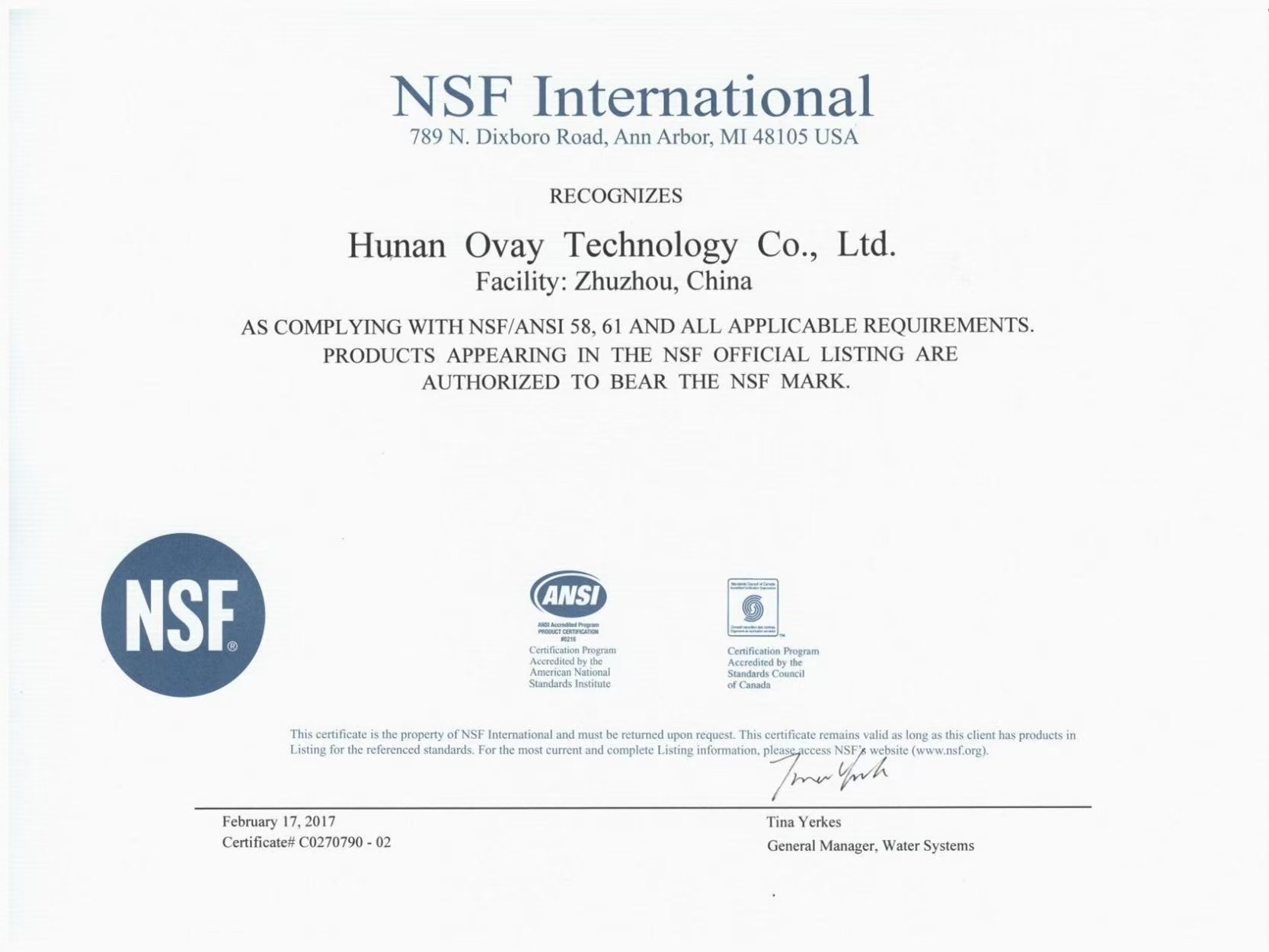
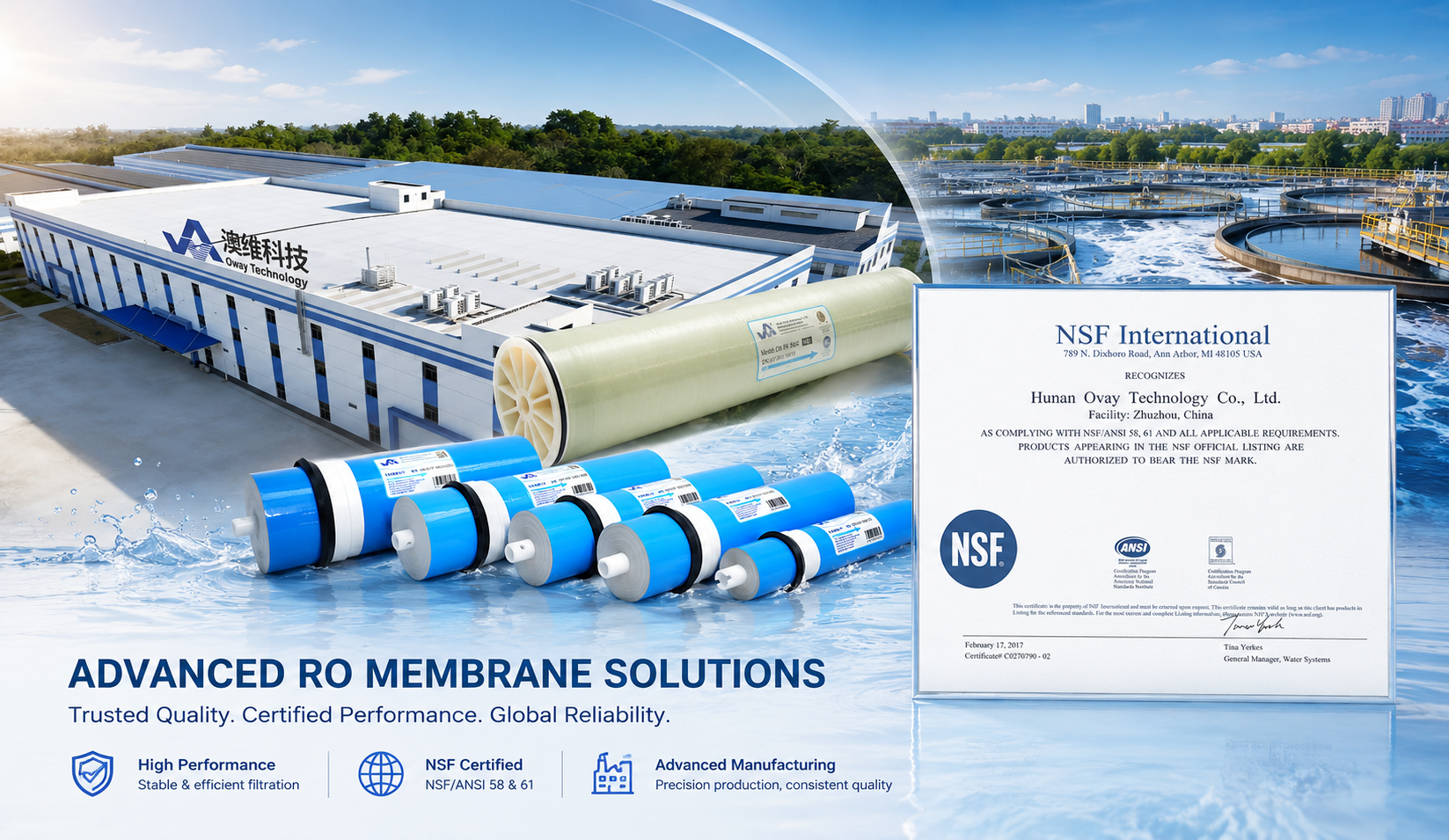
OVAY membranes manufactured by Hunan Ovay Technology Co., Ltd. carry NSF/ANSI 58 & 61 certification (Certificate # C0270790-02) under NSF International’s Drinking Water Treatment Units listings. Here’s why this matters for your OEM project:
1. Continuous Certification History
OVAY has maintained NSF certification since 2017. NSF performs annual facility audits and ongoing product testing to maintain certification — this isn’t a one-time stamp, it’s an ongoing verification of manufacturing quality and material consistency.
2. Material Composition Documentation
We provide full Bill of Materials documentation showing the polyamide thin-film composite chemistry, polysulfone support layer specifications, and polyester backing — exactly what NSF certification verifies.
3. NSF Certification Listings Accessible to Your Compliance Team
The certification can be independently verified at info.nsf.org/Certified/DWTU under "Hunan Ovay Technology." Your regulatory team or NSF auditor can confirm the certification directly through NSF’s official database — no paperwork from us required.
4. Certificate of Analysis (CoA) with Every Shipment
Each production batch ships with CoA documentation confirming the batch matches the certified specifications. This is the documentation NSF auditors look for when certifying your finished system.
What Your Compliance Documentation Package Includes
When you source OVAY membranes through Seven Pillars for your OEM project, your compliance documentation package includes:
| Document | Purpose |
|---|---|
| Current NSF Certificate (PDF) | Demonstrates active certification status |
| NSF Certification Listing Reference | Independent verification at info.nsf.org |
| Material Safety Data Sheet (MSDS) | Required for shipping, storage, regulatory filings |
| Bill of Materials (BOM) | Required for system-level certification of your finished product |
| Certificate of Analysis (CoA) | Per-batch confirmation of conformance |
| Manufacturing Facility Audit Reports (available on request) | For enterprise compliance reviews |
Common OEM Compliance Mistakes to Avoid
Mistake 1: Assuming Component Certification = Product Certification
NSF-61 certified membranes are an essential starting point, but you still need to certify your complete finished system to NSF/ANSI 58. Plan and budget for this process.
Mistake 2: Not Verifying the Certification Listing Yourself
Always independently verify the supplier’s NSF certification at info.nsf.org/Certified/DWTU. Marketing claims of "NSF certification" without a verifiable listing are red flags.
Mistake 3: Mixing Certified and Uncertified Components
If even one component in your finished system (fittings, tubing, post-carbon filter) doesn’t meet NSF/ANSI 61 material safety standards, your entire system fails certification.
Mistake 4: Skipping Annual Re-certification
NSF certification requires ongoing compliance. Manufacturers (including your OEM partners) undergo annual audits. Make sure your supplier’s certification is current — not just historically certified.
Mistake 5: Believing "Equivalent to NSF" Claims
Some suppliers claim their products are "equivalent to NSF-certified" or "tested to NSF standards." These are not the same as NSF certification. US regulators and retailers will not accept these substitutes.
How to Verify NSF Certification (For Your Compliance Team)
Any RO membrane supplier’s NSF claim can — and should — be verified in three steps:
- Visit info.nsf.org/Certified/DWTU
- Search for the manufacturer’s company name (e.g., "Hunan Ovay Technology")
- Confirm the listing includes:
- Active status (no expired/withdrawn notation)
- The specific membrane models you’re sourcing
- The standards covered (NSF/ANSI 58 and/or 61)
If a supplier’s claim doesn’t appear in this database, the claim is unverifiable — regardless of what their marketing materials say.
The Bottom Line for OEM Decision-Makers
NSF/ANSI 58 & 61 certification of your membrane source is the foundation — but not the entirety — of your compliance pathway in the US market. Choosing an OEM partner with a strong, independently verifiable certification history dramatically reduces your time-to-market and your regulatory risk.
At Seven Pillars, our authorized OEM partnership with OVAY gives your brand access to NSF certification maintained since 2017, complete compliance documentation packages, and direct support for your system-level certification process.
Ready to discuss your OEM compliance pathway? Contact our compliance team — we’ll send your full documentation package within 24 hours of your initial inquiry.